Cosmic Christmas John 1
When we think about the Christmas story, we naturally turn to Matthew and Luke—the genealogies, Mary and Joseph, the manger in Bethlehem. These passages are rich with detail about the earthly events surrounding Jesus's birth.
But the Gospel of John offers us something different. In just 18 verses, John pulls back the curtain to reveal what's really happening when Jesus enters our world. He gives us a cosmic perspective that changes everything.
As theology professor Edwin Blum notes, while Matthew begins with genealogy, Mark with John the Baptist, and Luke with a dedication to Theophilus, John starts with a theological prologue—as if to say, "You won't understand the good news of Jesus in its fullest sense unless you view Him from this point of view."
Let's explore the first three verses of John's Gospel and discover how this perspective can truly impact us still today.
Understanding "The Word"
John opens with these striking words:
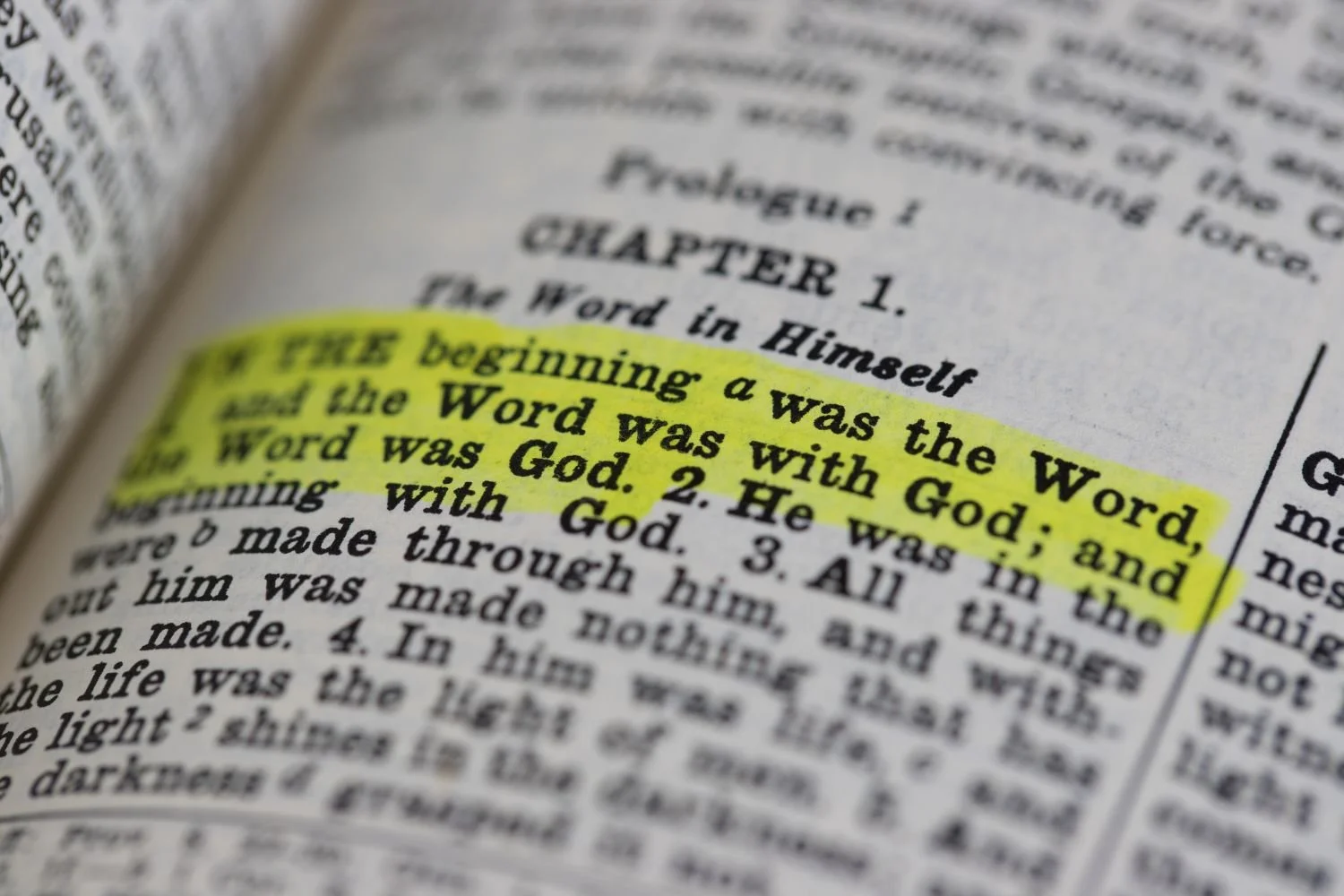
"In the beginning was the Word, and the Word was with God, and the Word was God." (John 1:1-3)
Who or what is "the Word"? John answers this question in verse 14:
"The Word became flesh and made his dwelling among us." The rest of his Gospel is about Jesus's life. So "the Word" is Jesus himself. (John 1:14)
But why use this title instead of simply saying "Jesus"?
What It Meant to the Greeks
For John's first-century audience, this title captured the attention of both Jews and Greeks. The Greek term John used was "Logos"—the root of our English word "logic."
To Greek philosophers, the Logos was far more than a word. It represented the rational principle of the universe, the creative energy from which all things came. The philosopher Heraclitus observed that while the world constantly changes, it never descends into chaos. He concluded there must be a stabilizing principle—an organizing force holding everything together.
When Greeks read John's opening, "In the beginning was the Logos," they immediately understood: John was putting a name to this principle they'd been seeking. But it isn’t a principle at all. The Word is a Person, and His name is Jesus.
What It Meant to the Jews
Jewish readers also grasped John's meaning immediately. The phrase "In the beginning" echoed Genesis 1:1, where God created the world through words—speaking everything into existence.
Psalm 33:6 confirms this:
"By the word of the Lord were the heavens made."
Throughout the Old Testament, we read of "the word of the Lord" coming to prophets like Isaiah, Ezekiel, and Jeremiah. For Jewish readers, "the Word" pointed directly to God himself.
As William Temple summarizes:
"The Logos, alike for Jew and Gentile, represents the ruling fact of the universe, and represents that fact as the self-expression of God... Both will agree that this Logos is the starting-point of all things."
John doesn't want us to miss this: when we see the baby Jesus in the manger, we're looking at the starting point of all things!
The Eternal Existence of Jesus
Let's look more closely at what John tells us in verse 1:
"In the beginning was the Word, and the Word was with God, and the Word was God." (John 1:1)
Before Time Began
"In the beginning" doesn't mean the beginning of eternity—eternity has no beginning or end. John is saying that before time itself existed, Jesus was already there. When creation came into existence, Jesus was already present.
In Relationship with God
The phrase "the Word was with God" carries deeper meaning in Greek. The word translated "with" literally means "toward," implying a face-to-face relationship. Jesus existed in the closest possible connection with God the Father—a forever, intimate relationship.
The Logos isn't a philosophical principle but a Person, distinct from the Father yet one in essence with Him.
Fully God
John states it plainly: "the Word was God." Could there be a clearer affirmation of Jesus's deity?
The verb "was" appears in the imperfect tense, indicating eternal existence. This is an absolute statement: there was never a time when Jesus was not.
He is God, yet He has been with God throughout eternity. This helps us understand the nature of the Godhead—God the Father and God the Son, both fully God, yet distinct Persons in relationship with each other. Combined with other Scripture revealing the Holy Spirit, we see the Trinity: three distinct Persons, one essence.
Why Repetition Matters
Verse 2 repeats what John just said:
"He was with God in the beginning." (John 1:2)
Why the repetition? Because important things bear repeating. John wants us to remember that the baby Jesus born 2,000 years ago didn't come into being in that moment. He has always existed as the eternal God the Son, in perfect relationship with God the Father.
This is the cosmic perspective: the God of the universe left heaven's glory, took on human nature, and was born into our world as the God-Man.
Jesus, the Creator of All Things
John continues building this perspective in verse 3:
"Through him all things were made; without him nothing was made that has been made." (John 1:3)
The Agent of Creation
The baby in the manger was the One who created all things. Not a principle or force, but a personal God who existed outside time's bounds—an eternal being who created everything. His name is Jesus.
The phrase "were made" uses the aorist tense in Greek, depicting creation as one complete act. There was a specific moment when things came into being—when Jesus spoke them into existence, as Genesis 1 describes.
Nothing we see today came into being apart from Jesus.
Why This Matters for Your Life Today
Many today argue that our world formed randomly—that Earth just happens to be the right distance from the sun, that we happen to have the exact oxygen-to-nitrogen ratio needed for life, that the gravitational constant, cosmological constant, and Hubble constant just happen to have the precise values necessary for life to exist.
Scientists have determined that if these values were off by even the smallest margin, no life could exist anywhere.
The Greeks understood this couldn't be random. They observed order and rhythm in how things work and concluded something must be behind it all.
John was confirming their instinct: "You're right! The Logos is a Person—an Intelligent Designer who existed outside creation and time itself, wise and powerful enough to create everything around us."
Creation: The Foundation of Redemption
Leon Morris, in his commentary on John's Gospel, captures something essential:
Creation is a foundational doctrine of the Christian faith. Virtually every other aspect of theology rests upon our understanding of God as the origin of all life and of the role Jesus Christ, the Word, in creation... Only God who created all things can redeem them. Creation is the foundation stone of the gospel. Christ could not have been created, for he created all things.
Only God who created all things can redeem them.
The Problem of Sin
Jesus created you and me to exist not independently of Him but in union with Him—with Him as our Source, experiencing eternal life with this eternal being.
But sin broke that relationship. A holy and perfect God cannot be in relationship with sinful humanity. A just God cannot let sin go unpunished.
The Solution: God Became Flesh
So what did God do? He became flesh.
The Word who existed in the beginning, who was with God and was God, squeezed himself into humanity. He took on human nature and was born into this world so He could take the punishment for our sins, making forgiveness possible and restoring us to the eternal relationship we were meant to have with Him.
You cannot redeem yourself. No amount of self-improvement or following steps to become your best self will be enough to deal with your sin problem before a holy and perfect God.
But because the Word became flesh, died on the cross for your sins, and rose from the dead, the purchase price for your salvation has been paid. Jesus offers you that salvation as a gift. All you have to do is receive it by placing your faith in Him.
Your Value to the God of the Universe
For those who have received this gift of redemption, remember how valuable you are to the God of the universe.
He created you. You are not here by random chance. You are valuable to Him. You have meaning. You have a purpose.
You are loved so much by the God of the universe that He was born into this world to suffer and die so that you could experience abundant life now and forevermore.
This Christmas Season
As you focus on Christmas this year, be reminded that Jesus is your Creator. As your Creator, He came into this world to redeem you.
You are valuable to Him. You have meaning and purpose in Him. He loves and cherishes you deeply.
Rest in Him and all that you have in Him today.